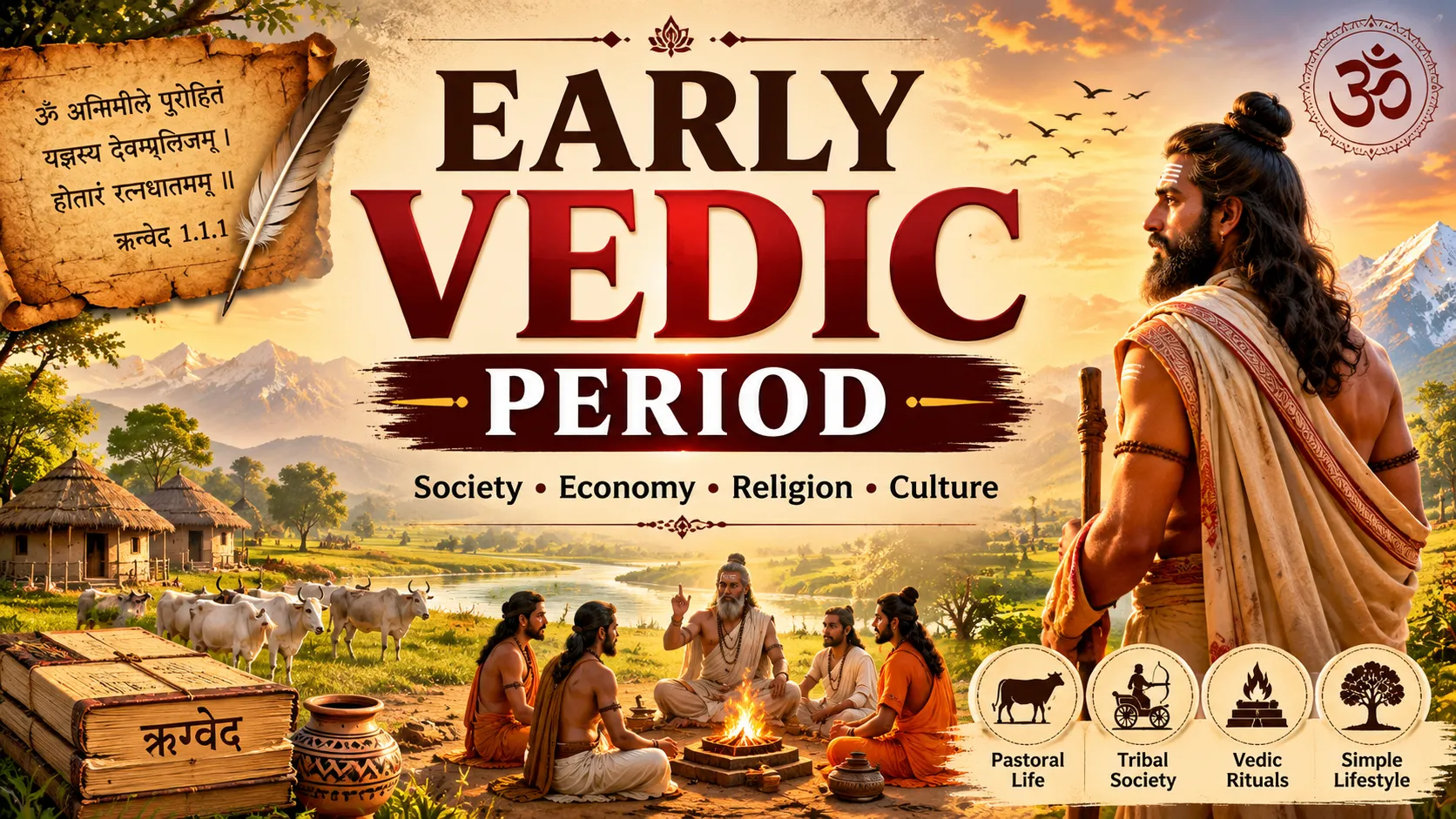
The Vedic civilization can be divided into:
- Early Vedic period or Rigvedic period (1500 BCE- 1000 BCE)
- Later Vedic Period (1000 BCE - 600 BCE)
EARLY VEDIC PERIOD
ARRIVAL OF ARYANS
The Kassite inscriptions in Iraq (1600 BC) and the Mitanni inscription (14th century BC) in Syria contain some Aryan names, suggesting that a branch of Aryans migrated eastward from Iran.
Cultural significance of Sapta Sindhu
The Sapta-Sindhu was not just a geographical zone but the cultural and spiritual heartland of the early Aryans.
Later, as Aryans expanded eastward, the focus shifted to the Ganga-Yamuna Doab, but the Rigvedic hymns preserve the memory of the western rivers.
| Vedic Name | Modern Name / Identification | Notes |
|---|---|---|
| Sindhu | Indus River | Major river of Rigveda; gave India its name. |
| Vitasta | Jhelum | Flows through Kashmir. |
| Asikni | Chenab | Known for dark waters. |
| Parushni | Ravi | Site of the famous Battle of Ten Kings. |
| Vipasha | Beas | Means “unfettered.” |
| Shutudri | Sutlej | Westernmost tributary of Indus. |
| Saraswati | Ghaggar-Hakra (dry river bed) | Revered as Naditarna (“river par excellence”). |
| Kubha | Kabul River (Afghanistan) | Shows Aryan presence westward. |
| Drishadvati | Chautang (seasonal river, Haryana) | Mentioned with Saraswati as defining Brahmavarta. |
Aryans were better equipped to face their adversaries. Their soldiers had horse ridden chariots, coats of mail (varman) and better arms made of bronze. Indra, the main god, was also called Purandara in Rigveda, which means 'breaker of forts'. Many hymns describe Indra destroying the forts (pura) of enemies, which reflects the war-like nature of the age. The Rigveda portrays a society constantly engaged in battles — for cattle, land, and dominance. Victory was celebrated as divine favor, especially from Indra. In Rigveda, an Aryan chief who overpowered dasyus was called Trasadasyu. His name itself suggests “terror to enemies.” Similarly, it mentions the defeat of Sambara (a powerful dasyu leader) on hands of king Divodasa, who belonged to Bharata clan of Aryan tribes. The Rigveda refers to the Aryan community being divided into five major clans. Among them, the Bharatas and Tritsus were dominant and often portrayed as ruling clans. The later name of the country, Bharatavarsha, is traditionally traced to the Bharata clan. This shows how tribal identity evolved into a broader cultural identity.
In addition to this, the Rigveda also records the famous Battle of Ten Kings (Dasarajna Yuddha), where King Sudas of the Bharata clan defeated a confederacy of ten tribes on the banks of the river Parushni (modern Ravi). This was a turning point in Aryan tribal politics. After the battle, the Purus, one of the defeated clans, later allied with the Bharatas, and together they formed the Kuru tribe, which became the most influential political and cultural force in the Later Vedic period. The role of priests like Vasishta and Vishwamitra was crucial in guiding kings and clans, while assemblies such as sabha, samiti, vidatha, and gana assisted the rajan in decision-making. Most wars were fought for cattle (gavishti), which were the primary measure of wealth, showing how economic motives were deeply tied to warfare.
How Was Early Vedic Political Organisation?
Jana (Tribe) The highest political unit was the jana or tribe. Mentioned 275 times in the Rigveda. The term janapada (territory) is absent, showing the community was still semi-nomadic.
Tribal Kingdoms
Several tribal kingdoms existed during the Rigvedic period, such as:
Economic & Social Life in the Rigvedic Period
Being a pastoral society, there are a lot of references about cows in Rigveda. Cows were considered an important form of wealth. In fact most of the wars were fought in the name of cows. The Vedic term for war is gavishti, meaning search for cows. The gifts given to priests were in the form of cows and slave women and not in the form of lands or cereals.
They practised sowing and harvesting and had a great knowledge about different seasons. Barley was the main grain cultivated. But, most of their agriculture was for fodder crops. Ploughshare finds mention in Rigveda. Probably they used wooden ploughs.
Apart from cows, horses were also very important for Aryans and have enabled them to travel long distances.
Metal usage: The term ayas was used to refer copper or bronze. They might have obtained copper from Khetri mines in Rajasthan.
People engaged in different activities. There were artisans such as carpenter, chariot maker, weaver, leather worker, potter etc.
Gavyuti was a unit of distance and godhuli was the unit of time in Vedic period.
There is no clear evidence of long-distance trade during the Vedic period. Trade, if existed, was of primitive nature. The community used barter system to exchange goods among themselves. The trader class of citizens were called pani as per the Rigveda.
Rigveda mentions the use of nishka as throat ornament. However, historians believed that it gradually evolved as a unit of value for goods (primitive currency).
Similarly, Aryans might not have been acquainted with sea, since the term samudra mentioned in Rigveda is just for a collection of water.
The basic unit of society was family or griha. The head of the family was called grihapati.
Status of Women: Vedic society was patriarchal. Births of sons were generally desired. However, the system was not as rigid as later times. They could attend tribal assemblies. They could also offer sacrifices with their husbands. They also composed some hymns. There were women poets like Apala, Viswavara, Ghosa and Lopamudra during the Rig Vedic period and they were called brahmavadini. Monogamy was generally practised; however, there are instances of polyandry and polygyny. They also practised widow-remarriage and levirate (marrying husband’s brother on the death of husband), however there was no child marriage.
Cattle as Currency: Cows were not only wealth but also a medium of exchange, almost functioning like currency.
Seasonal Awareness: Rigvedic hymns show a keen observation of natural cycles, linking agriculture with ritual calendars.
Women’s Role: The participation of women in assemblies and hymn composition reflects a relatively higher status compared to later periods.
Social Division in Rigvedic Period
Social division on the basis of occupation started during this time, but it was not rigid.
The spoils of war were mainly shared by the chiefs and priests, which created social inequality gradually.
Varna system: Rigveda gives some indication that varna (colour) was used to differentiate among people. Aryans were fair and indigenous people were dark. The dasas and the dasyus were treated as slaves by the Aryans.
By the end of the Rigvedic period, society was divided into four groups: warriors, priests, the people, and shudras.
Viswamitra composed the Gayatri Mantra to increase the Aryan fold. Later it became the monopoly of the upper castes and men.
Religion in Rigvedic Period
Vedic people personified various forces in nature and looked upon them as gods.
Indra: He is the most important divinity, also called Purandara or breaker of forts. He was the rain god and around 250 hymns are devoted to him in Rigveda.
Agni: He is the fire god and was the second most important god. He acted as an intermediary between the gods and the people.
Varuna: He is the god of water and upholds the natural order.
Soma: The god of plants. An intoxicating drink is also named after him and considered important in prayers.
Key Clarifications
Brahmavarta is not the First Aryan conquest: It was not a conquered territory but a sacred cultural heartland defined in texts.
Aryan migrations: The Aryans initially lived in northwest India and Afghanistan, then gradually moved eastward.
Later expansion: By the late Vedic period, Aryavarta extended across the Ganga-Yamuna Doab and eventually to Bengal.
Many scholars identify it with the Ghaggar-Hakra river system, which dried up later.
Saraswati is especially revered, described as Naditarna (“the river par excellence”).
This table captures the Sapta-Sindhu core rivers plus other Rigvedic rivers like Kubha and Drishadvati, which are important for exam answers.
UPSC Prelims PYQs – Early Vedic Period (Year-wise)
1993
Q. Which one of the following rivers is mentioned most frequently in the Rigveda?
A. Ganga
B. Yamuna
C. Saraswati
D. Narmada
Answer: C. Saraswati
1994
Q. Which one of the following Vedas contains sacrificial formulae?
A. Rigveda
B. Samaveda
C. Yajurveda
D. Atharvaveda
Answer: C. Yajurveda
1995
Q. The deity most frequently mentioned in the Rigveda is
A. Varuna
B. Agni
C. Indra
D. Vishnu
Answer: C. Indra
2001
Q. The staple crop of the Vedic Aryans was
A. Barley
B. Rice
C. Wheat
D. Millets
Answer: A. Barley
2012
Q. Which one of the following statements is correct?
A. In the Rigveda, Aditi is the Goddess of wealth.
B. In the Rigveda, the word 'Aghanya' is used for cow.
C. The Rigvedic society was matriarchal.
D. The Rigveda originally contained 1000 hymns.
Answer: B. In the Rigveda, the word 'Aghanya' is used for cow.
2014
Q. The Rigvedic people
- worshipped Indra, Varuna and Agni.
- practised animal sacrifice.
- knew the use of iron.
Select the correct answer using the code given below.
A. 1 only
B. 2 and 3 only
C. 1 and 2 only
D. 1, 2 and 3
Answer: C. 1 and 2 only
Other PYQs Related to Vedic Literature (Indirectly Relevant)
1997
Q. The two great epics and the major Puranas were finally compiled during
A. Mauryan Period
B. Gupta Period
C. Kushana Period
D. Post-Gupta Period
Answer: B. Gupta Period