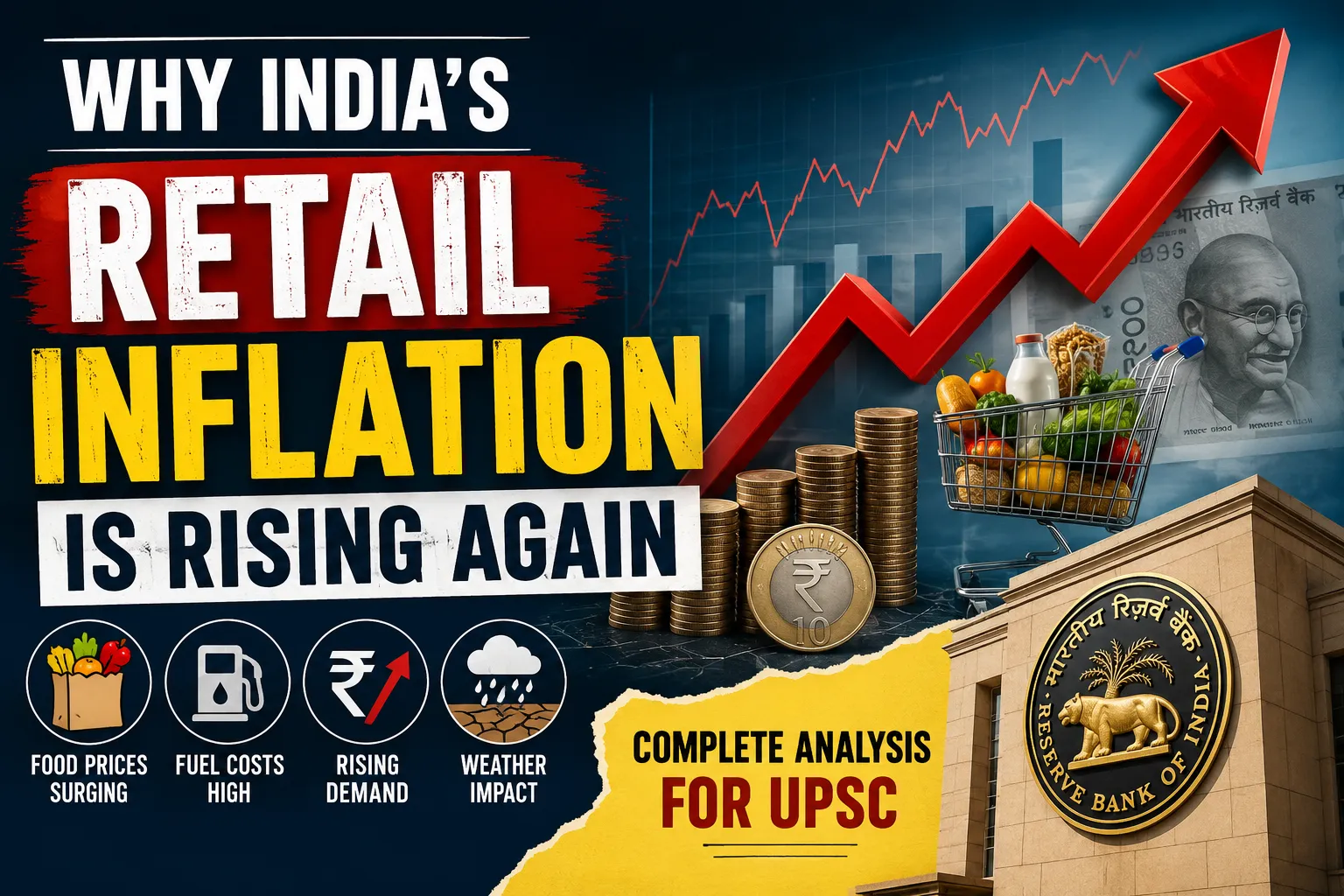
India’s retail inflation is rising again, and that matters because it affects the price of almost everything people buy. From vegetables and milk to fuel, transport, and household essentials, a rise in inflation changes the cost of daily life in a very direct way. The main measure behind this is the Consumer Price Index, or CPI, which tracks how much the average consumer basket costs over time.
This is not just a technical economic issue. When inflation rises, families feel it in the grocery bill, small businesses face higher input costs, and policymakers have to think carefully about interest rates and growth. The reason inflation is moving up again is usually not one single factor, but a mix of food prices, weather conditions, fuel costs, supply bottlenecks, and global commodity movements.
What Is Retail Inflation?
Retail inflation means the increase in prices that consumers pay for goods and services in the market. If the same basket of items costs more today than it did a year ago, retail inflation has risen. In India, this is measured mainly through the Consumer Price Index.
CPI is important because it reflects what households actually experience. It includes everyday items such as food, fuel, clothing, housing, health, education, and transport. That makes it a useful measure of the real cost of living.
To put it simply, if your monthly budget used to cover a certain set of expenses and now it covers less, inflation is eating into your purchasing power. Even if income stays the same, prices rising steadily can make life feel more expensive.
Why CPI Matters So Much
CPI is one of the most closely watched economic indicators in India because it affects both households and policy decisions. For families, it shows whether essentials are becoming harder to afford. For the government and the central bank, it signals whether price pressure is under control or becoming a problem.
The Reserve Bank of India uses CPI inflation as the key measure for monetary policy. If inflation stays too high for too long, the RBI may keep interest rates unchanged or avoid cutting them quickly. That affects loans, EMIs, savings, and business borrowing.
CPI also matters because it is a direct reflection of daily life. A rise in this index is not a distant economic event. It is something people feel every time they go to buy food, refill fuel, or pay for transport.
Why Retail Inflation Is Rising Again
There is usually no single reason behind an inflation rise. In India, the recent upward pressure on inflation can generally be explained by a combination of food inflation, weather shocks, fuel costs, and supply-side issues.
Food prices are often the biggest driver. If vegetables, cereals, pulses, milk, or edible oils become more expensive, the overall CPI rises quickly because food has a large weight in the consumer basket. Even a short-lived spike can push the headline number higher.
Weather also plays a major role. Excess rain, heatwaves, floods, or delayed monsoons can damage crops and disrupt supply. When production falls or transport becomes difficult, prices usually increase. This is especially common for perishable items like vegetables, fruits, and dairy products.
Fuel and transport costs matter too. If fuel becomes expensive, the cost of moving goods from farms, factories, and warehouses to markets also rises. That increase is then passed on to consumers in the form of higher prices.
Global commodity prices can also affect India. Crude oil, edible oils, fertilizers, and other imported goods become costlier when international prices rise or when the rupee weakens. Even if domestic demand is stable, imported inflation can still push up retail prices.
Why Food Inflation Hits Hardest
Food inflation is the most sensitive part of inflation in India because food is a basic necessity and a major share of household spending. Many families spend a large portion of their income on groceries and daily essentials. That means even a small increase in food prices can create noticeable pressure.
Vegetables are especially volatile. Tomato, onion, and potato prices often rise or fall sharply depending on harvest conditions, storage, transport, and seasonal changes. A bad crop or supply disruption can quickly show up in household budgets.
Cereals and pulses also matter because they are staple foods. Milk, edible oil, and spices can also influence inflation because they are used regularly across homes. When several of these items become expensive at the same time, the overall inflation number rises more strongly.
This is one reason India’s inflation pattern often looks uneven. Prices do not rise evenly across all items. Instead, food often leads the movement, while other categories may remain more stable.
How Weather Affects Inflation
India’s food supply is still closely linked to agriculture, so weather has a direct impact on prices. A weak monsoon, unseasonal rainfall, drought, or heatwave can affect crop output. If harvests are damaged or delayed, supply falls and prices rise.
Weather problems also affect transport and storage. Heavy rain can damage roads, interrupt movement of goods, and spoil perishable items. Heat can reduce the shelf life of food, while floods can destroy crops before they reach the market.
This is why inflation often rises after weather shocks, even when overall demand in the economy has not changed much. The issue is not always people buying more. Sometimes the problem is simply that there is less supply available.
Headline Inflation and Core Inflation
To understand inflation properly, it helps to know the difference between headline inflation and core inflation. Headline inflation includes everything in the CPI basket, especially food and fuel. Core inflation excludes food and fuel, which are usually more volatile.
Headline inflation is what most people feel directly because it captures the actual rise in household expenses. But core inflation helps economists see whether inflation is spreading across more sectors. If core inflation stays low while headline inflation rises, the problem may be temporary. If core inflation also rises, the inflation pressure may be broader and more persistent.
This distinction is important because it helps policymakers decide whether inflation is just a short-term shock or a deeper trend. A food price spike may pass quickly, but broad-based inflation is more difficult to control.
How CPI Is Calculated
The CPI is based on a basket of goods and services that represent household spending. Each item in the basket is given a weight according to its importance in the average consumer’s budget. Food generally has a large weight, which is why it plays such a strong role in the final number.
The current prices of these items are compared with a base year. If the overall cost of the basket rises, inflation rises. The year-on-year inflation rate compares the current month with the same month in the previous year.
This method helps smooth out some short-term changes, but it also means that inflation can remain elevated if prices stay high for a long period. Even if the monthly rise is small, the annual number can still be uncomfortable if prices remain stubbornly high compared to last year.
Why People Feel Inflation More Than the Statistics Suggest
Official inflation figures are averages. They do not match every household perfectly. A family that spends more on vegetables, fuel, rent, or transport may feel inflation much more sharply than the headline number suggests.
Urban and rural households also experience inflation differently. Urban families may feel more pressure from housing, commuting, and services. Rural families may be hit harder by food prices and transport costs. Lower-income households are usually the most affected because essentials take up a larger share of their monthly budget.
This is why inflation is not only about economics. It is also about daily stress, spending choices, and household planning. When prices rise, people often reduce non-essential purchases, postpone big expenses, or shift to cheaper alternatives.
What the RBI Watches Closely
The RBI keeps a close eye on CPI because controlling inflation is one of its main responsibilities. If inflation stays above target, the central bank may avoid rate cuts or keep policy tight for longer. The aim is to prevent prices from rising too fast and becoming harder to control later.
This matters because interest rates affect many parts of the economy. Home loans, car loans, business loans, and personal borrowing all become more expensive when rates stay high. So inflation affects not only groceries but also broader financial conditions.
At the same time, the RBI cannot solve supply shocks by itself. It can manage demand, but it cannot directly grow more vegetables or stop extreme weather. That is why inflation control in India needs both monetary policy and supply-side improvement.
Can Inflation Be Controlled?
Inflation can be managed, but it cannot always be eliminated. The best solution is usually a combination of better crop planning, stronger storage systems, efficient transport, and timely market intervention. If food supply becomes more stable, inflation spikes may become less severe.
Improving cold storage, warehouse capacity, logistics, and crop forecasting can reduce volatility in food prices. Better distribution systems can also help move food from surplus regions to deficit regions more quickly. These steps do not create instant results, but they help reduce repeated price shocks.
On the monetary side, the RBI can use interest rates and policy guidance to keep inflation expectations under control. That helps prevent temporary price rises from turning into a long-lasting inflation cycle.
Why This Inflation Rise Matters Now
The current rise in retail inflation matters because it reminds us that price stability is fragile. Even after inflation eases for a while, it can rise again if food supply is hit, fuel prices increase, or global commodity costs move higher. This is why inflation monitoring never really stops.
For households, the rise means more pressure on budgets. For businesses, it means higher input costs. For the government and the RBI, it means careful balancing between growth and price stability.
In simple terms, inflation rising again means the cost of living is moving up faster than people would like. If the rise is driven mostly by food and temporary supply shocks, it may cool later. But if price pressure becomes broad-based, it becomes a bigger economic concern.
Conclusion
India’s retail inflation is rising again because several forces are pushing prices upward at the same time. Food inflation, weather-related supply shocks, fuel costs, and global commodity prices are all part of the story. CPI captures these changes and shows how expensive everyday life is becoming for consumers.
The important thing to understand is that inflation is not just a number in a government report. It affects what families buy, how they budget, how businesses plan, and how the RBI sets policy. That is why CPI remains one of the most important indicators in the Indian economy.
If inflation stays elevated, the pressure on households will continue. If supply conditions improve, price growth may ease again. Either way, understanding CPI helps explain why people feel that prices are rising even when the economy appears to be moving normally.
FAQ
What is CPI in simple words?
CPI, or Consumer Price Index, is a measure of how much the prices of common household goods and services have changed over time.
Why is retail inflation important?
Retail inflation matters because it shows how much more people need to spend to buy the same everyday items.
Why do food prices affect inflation so much in India?
Food has a large weight in the CPI basket, so changes in food prices quickly affect the overall inflation number.