Introduction to the Big Bang Theory
As a science educator navigating the complex landscape of modern education, managing study materials for students can be a daunting task. Whether you are using a productivity platform for teams like Asana, Notion, or Monday.com to organize lesson plans, the core content you deliver to your students must remain robust, engaging, and academically rigorous. One of the most fascinating and challenging topics to teach—and for students to master—is the origin of our universe.
For students preparing for highly competitive examinations like the UPSC Civil Services Exam, or those studying under the NCERT CBSE curriculum, understanding the cosmos is not merely a matter of curiosity; it is a fundamental requirement. The Big Bang Theory stands as the cornerstone of modern cosmology, offering a profound explanation for the universe's origin, its expansion, and the formation of celestial bodies.
This comprehensive guide is designed specifically for UPSC aspirants and NCERT CBSE Class 11 Geography students. It breaks down the complex astrophysical concepts into digestible, structured notes that can be easily integrated into your study routine or teaching materials.
The Syllabus Context: UPSC and NCERT CBSE Alignment
Before diving into the scientific details, it is crucial to understand where this topic fits within the broader academic frameworks of UPSC and NCERT CBSE.
UPSC General Studies Paper I
In the UPSC Civil Services Examination, Geography is a vital component of the General Studies Paper I (GS-I) syllabus under the heading "Geography of the World." The syllabus explicitly requires candidates to understand the origin and evolution of the universe, the solar system, the earth, and the principles of physical geography. The Big Bang Theory provides the foundational knowledge required to answer questions related to:
•The origin of the universe and its continuous expansion.
•The formation of stars, galaxies, and planetary systems.
•The evolution of the Earth's atmosphere and hydrosphere.
NCERT Class 11 Geography (Fundamentals of Physical Geography)
For CBSE students, Chapter 2 of the NCERT Class 11 Geography textbook, titled "The Earth," is entirely dedicated to the origin and evolution of the Earth. The chapter transitions from early theories (like the Nebular Hypothesis) to modern theories, prominently featuring the Big Bang Theory. Understanding this chapter is not just about passing school exams; it builds the base knowledge necessary for competitive exams like the UPSC.
As an educator, aligning your teaching materials with these specific syllabus requirements ensures that students are not wasting time on extraneous information but are instead focusing on high-yield content.
The Early Theories: Beyond the Big Bang
To fully appreciate the Big Bang Theory, one must first understand the historical context of cosmological thought. Before the advent of modern astronomy, early philosophers and scientists attempted to explain the origin of the Earth and the universe using the knowledge available to them.
The Nebular Hypothesis
One of the earliest and most popular arguments was proposed by the German philosopher Immanuel Kant in 1755. In 1796, the French mathematician Pierre-Simon Laplace revised this concept, leading to what is now known as the Nebular Hypothesis.
The Nebular Hypothesis posited that the planets were formed out of a cloud of material (a nebula) associated with a youthful, slowly rotating sun. In 1950, scientists Otto Schmidt (Russia) and Carl Weizsäcker (Germany) somewhat revised this hypothesis, suggesting that the sun was surrounded by a solar nebula containing mostly hydrogen and helium, along with dust. The friction and collision of particles led to the formation of a disk-shaped cloud, and the planets were formed through the process of accretion.
While the Nebular Hypothesis was groundbreaking for its time, it primarily focused on the origin of the solar system and the Earth, rather than the entire universe. As technology advanced and observational astronomy improved, scientists shifted their focus to the broader cosmos, leading to the development of modern theories regarding the origin of the universe.
Modern Theories: The Expanding Universe
The most popular and widely accepted argument regarding the origin of the universe is the Big Bang Theory, also known as the Expanding Universe Hypothesis. This theory marks a significant departure from static models of the universe, proposing that the cosmos is dynamic and constantly changing.
Edwin Hubble's Discovery
In 1929, American astronomer Edwin Hubble provided crucial empirical evidence that the universe is expanding. By observing distant galaxies, Hubble discovered that they were moving away from Earth. Furthermore, the farther away a galaxy is, the faster it appears to be moving. This relationship is now known as Hubble's Law.
To visualize this expansion, educators often use a simple analogy: a balloon. If you take a balloon and mark several points on it to represent galaxies, and then begin inflating the balloon, you will observe that the points marked on the balloon appear to be moving away from each other as the balloon expands. Similarly, the distance between the galaxies is found to be increasing, indicating that the universe itself is expanding.
However, it is important to note a critical distinction in this analogy. While the points (galaxies) on the balloon move apart as it inflates, the points themselves also expand. Scientific observations do not support the expansion of the galaxies themselves. Scientists believe that while the space between the galaxies is increasing, the galaxies are not expanding in size. Therefore, the balloon example is only partially correct, but it serves as a useful conceptual tool for students.
The Stages of the Universe's Development
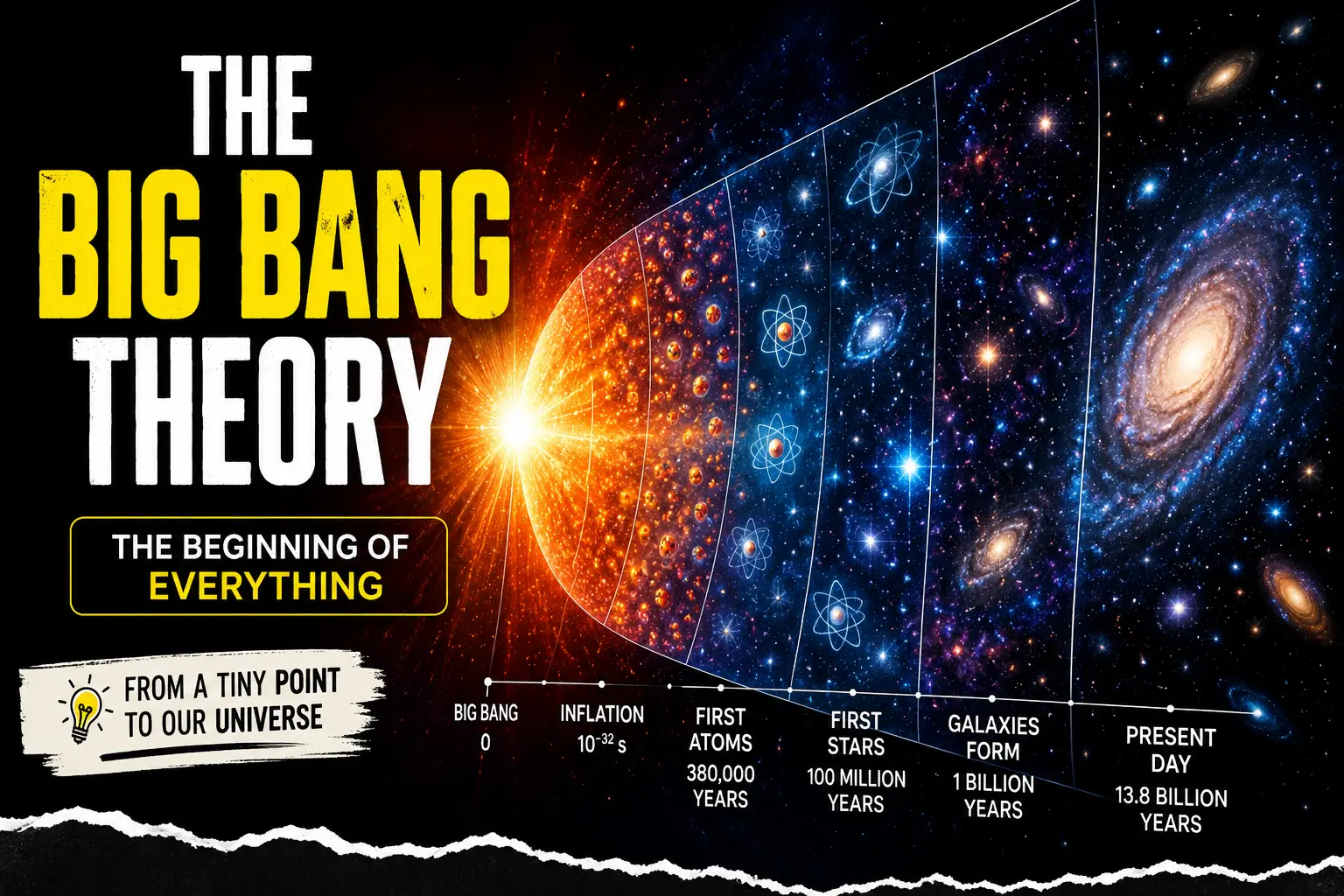
The Big Bang Theory is not merely a statement that the universe is expanding; it provides a detailed, step-by-step account of how the universe evolved from its initial state to its current form. Understanding these stages is essential for UPSC and CBSE students, as questions often test the chronological sequence of cosmic events.
Stage 1: The Singularity
In the beginning, all matter forming the universe existed in one place in the form of a "tiny ball" (singular atom) with an unimaginably small volume, infinite temperature, and infinite density. This point of infinite density is referred to as a singularity. At this stage, the laws of physics as we understand them today did not apply.
Stage 2: The Big Bang and Rapid Expansion
At the Big Bang, the "tiny ball" exploded violently, leading to a huge expansion. It is now generally accepted that this event took place approximately 13.7 billion years ago (some recent estimates suggest 13.8 billion years).
The expansion continues even to the present day. As the universe grew, some energy was converted into matter. There was particularly rapid expansion within fractions of a second after the bang, a phenomenon known as cosmic inflation. Thereafter, the expansion slowed down.
Stage 3: Formation of the First Atoms
Within the first three minutes from the Big Bang event, the first atoms began to form. The extreme temperatures began to drop sufficiently to allow the formation of particles that would later become atoms.
Within 300,000 years from the Big Bang, the temperature dropped to 4,500 Kelvin (K) and gave rise to atomic matter. At this point, the universe became transparent. Primordial elements—primarily Hydrogen, Helium, and trace amounts of Lithium—condensed through gravity. These light elements are still the most abundant elements in the universe today.
Stage 4: The "Echo" of the Big Bang
Astronomers cannot literally peer back into the universe's birth due to the limitations of current technology. However, they can observe the "echo" of the expansion through a phenomenon known as the Cosmic Microwave Background (CMB) radiation. This radiation is the residual heat from the Big Bang, which has cooled down to just 2.725 degrees Kelvin (-270.425 degrees Celsius) as the universe expanded. The discovery of CMB radiation by Arno Penzias and Robert Wilson in 1965 was a monumental piece of evidence that solidified the Big Bang Theory, earning them the Nobel Prize in Physics.
Star and Planet Formation
The expansion of the universe and the cooling of matter set the stage for the formation of celestial bodies. The transition from a uniform soup of particles to the structured universe we observe today is a fascinating process.
The Formation of Galaxies and Stars
The distribution of matter and energy was not perfectly even in the early universe. These initial density differences gave rise to differences in gravitational forces, which caused the matter to get drawn together. These dense regions formed the bases for the development of galaxies.
A galaxy contains a large number of stars and spreads over vast distances, often measured in thousands of light-years. The diameters of individual galaxies range from 80,000 to 150,000 light-years. (A light-year is a measure of distance, representing the distance light travels in one year, which equals approximately 9.461 × 10¹² km).
A galaxy starts to form by the accumulation of hydrogen gas in the form of a very large cloud called a nebula. Eventually, the growing nebula develops localized clumps of gas. These clumps continue to grow into even denser gaseous bodies, giving rise to the formation of stars. The formation of stars is believed to have taken place some 5 to 6 billion years ago in the regions that would eventually form our solar system.
The Formation of Planets
The development of planets is a process that occurs in conjunction with star formation. The stages in the development of planets, as outlined in the NCERT curriculum, are as follows:
1.Formation of the Gas Cloud: The stars are localized lumps of gas within a nebula. The gravitational force within these lumps leads to the formation of a core to the gas cloud. A huge rotating disc of gas and dust develops around the gas core.
2.Formation of Planetesimals: In the next stage, the gas cloud starts getting condensed, and the matter around the core develops into small, rounded objects. These small-rounded objects, through the process of cohesion, develop into what are called planetesimals.
3.Accretion and Planet Formation: In the final stage, a large number of smaller planetesimals accrete (come together) to form a fewer large bodies in the form of planets. Larger bodies start forming by collision, and gravitational attraction causes the material to stick together.
This process explains the origin of our solar system, including the formation of the Earth, which we will explore in greater detail in the next section.
Evolution of the Earth and Atmosphere
The planet Earth, as we know it today, was not always a vibrant, blue-and-green oasis of life. Initially, the Earth was a barren, rocky, and hot object with a thin atmosphere composed primarily of hydrogen and helium. The transition from this hostile environment to a life-sustaining planet is a critical component of the UPSC and CBSE syllabus.
Evolution of the Lithosphere
During its primordial stage, the Earth was mostly in a volatile state. Due to a gradual increase in density, the temperature inside the Earth increased. As a result, the material inside started getting separated depending on their densities, a process known as differentiation.
Heavier materials, such as iron, sank towards the center of the Earth, while lighter materials moved towards the surface. With the passage of time, the Earth cooled further, solidified, and condensed into a smaller size. This led to the development of the outer surface in the form of a crust.
The formation of the moon, believed to be the result of a "giant impact," further heated up the Earth. Through the process of differentiation, the Earth-forming material got separated into different layers: the crust, mantle, outer core, and inner core. From the crust to the core, the density of the material increases significantly.
Evolution of Atmosphere and Hydrosphere
The present composition of Earth's atmosphere is chiefly contributed by nitrogen and oxygen. However, the early atmosphere was vastly different. There were three primary stages in the evolution of the present atmosphere:
1.Loss of Primordial Atmosphere: The early atmosphere, consisting mainly of hydrogen and helium, was stripped off as a result of solar winds. This phenomenon affected not only the Earth but all terrestrial planets.
2.Evolution of the Secondary Atmosphere: During the cooling of the Earth, gases and water vapor were released from the interior solid Earth. This process is called degassing. Continuous volcanic eruptions contributed water vapor and gases to the atmosphere. The early atmosphere largely contained water vapor, nitrogen, carbon dioxide, methane, and ammonia, with very little free oxygen.
3.Modification by the Living World: As the Earth cooled, the water vapor released started getting condensed. The carbon dioxide in the atmosphere got dissolved in rainwater, and the temperature further decreased, causing more condensation and more rains. The rainwater falling onto the surface collected in depressions, giving rise to oceans. The Earth's oceans were formed within 500 million years from the formation of the Earth.
Life began to evolve around 3.8 billion years ago. Around 2.5 to 3 billion years ago, the process of photosynthesis evolved. Life was initially confined to the oceans, which began to receive contributions of oxygen through photosynthesis. Eventually, oceans became saturated with oxygen, and approximately 2 billion years ago, oxygen began to flood the atmosphere, fundamentally altering its composition and paving the way for complex life forms.
Evidence Supporting the Big Bang Theory
While the Big Bang Theory is the prevailing cosmological model, it is not merely a speculative hypothesis. It is supported by a robust array of observational evidence and mathematical models. For competitive exams, understanding the evidence is often as important as understanding the theory itself.
Hubble's Law and Redshift
Hubble's Law states that galaxies move away from us at a rate proportional to their distance. This observation was made by Edwin Hubble in 1929. The phenomenon of Redshift is the primary mechanism behind this observation.
When a light source moves away from its observer, the apparent wavelength of the light is stretched towards the red part of the spectrum by the Doppler effect. Because the farthest galaxies had the fastest apparent velocities, Hubble's observation implied that distant galaxies were moving away from us. This empirical evidence strongly supports the expansion of the universe, suggesting that it was once compacted at a single point.
Cosmic Microwave Background (CMB) Radiation
As mentioned earlier, the universe was initially very hot. If the Big Bang Theory is correct, we should be able to find remnants of this heat. In 1965, Arno Penzias and Robert Wilson discovered the Cosmic Microwave Background (CMB) radiation, a faint microwave signal that permeates the observable universe, with a temperature of 2.725 degrees Kelvin.
The discovery of CMB radiation was a monumental piece of evidence for the Big Bang Theory. Missions like the Cosmic Background Explorer (COBE), the Wilkinson Microwave Anisotropy Probe (WMAP), and the Planck satellite have mapped this radiation with increasing precision, revealing minute temperature fluctuations that correspond to the slight density variations in the early universe. These fluctuations eventually led to the formation of galaxy clusters and large-scale structures.
Abundance of Light Elements
The Big Bang Theory predicts that the early universe produced specific amounts of light elements, primarily hydrogen and helium, through a process called Big Bang nucleosynthesis. Observations of the universe confirm that hydrogen and helium are indeed the most abundant elements, existing in ratios that closely match the theoretical predictions of the Big Bang model.
Misconceptions about the Big Bang Theory
Despite its widespread acceptance, the Big Bang Theory is subject to several common misconceptions. Addressing these is crucial for students preparing for exams, as questions may be framed to test the candidate's understanding of the theory's limitations.
Misconception 1: The Big Bang was an explosion in space
The most frequent misunderstanding is that the Big Bang was a massive explosion that occurred within pre-existing space. In reality, the Big Bang describes the expansion of space itself. It is not an explosion in space, but rather an expansion of space. The "tiny ball" of matter and energy did not explode into empty space; rather, space itself stretched and expanded.
Misconception 2: The Big Bang explains the ultimate origin of the universe
Another common misconception is that the Big Bang Theory explains what caused the universe to be created or what existed before the Big Bang. The theory only explains how the universe evolved from a very small, dense state to what it is today. It makes no attempt to explain the ultimate origin of the universe, what happened at the exact moment of the singularity, or what exists outside the observable universe.
Productivity for Science Educators: Managing Content and Study Materials
As a science educator, your role extends beyond simply delivering content; it involves curating, organizing, and disseminating information effectively. In today's digital age, productivity platforms for teams are invaluable tools for managing educational resources.
Leveraging Collaboration Tools
Platforms like Notion, Asana, or Trello can be used to create structured databases of study materials. For instance, when teaching the Big Bang Theory, an educator can create a project board where each column represents a stage of the universe's evolution. Cards within these columns can contain detailed notes, links to NCERT PDFs, and practice questions for UPSC aspirants.
Streamlining Content Delivery
By utilizing these platforms, educators can ensure that students have access to the most up-to-date and syllabus-aligned materials. This approach not only saves time but also ensures consistency in the delivery of complex topics like cosmology and physical geography. The structured nature of these platforms mirrors the logical flow required in academic writing and study guides, making them an ideal choice for managing large volumes of educational content.
Conclusion
The Big Bang Theory remains the most widely accepted and scientifically robust explanation for the origin and evolution of the universe. For UPSC and NCERT CBSE students, a thorough understanding of this theory is indispensable. It provides the foundational knowledge required to comprehend the physical geography of our world, from the formation of the solar system to the evolution of the Earth's atmosphere.
By breaking down the theory into its core components—early theories, the stages of cosmic development, star and planet formation, and the evidence supporting the model—students can master this complex topic. Furthermore, for science educators, utilizing productivity platforms to organize and deliver this content can significantly enhance the learning experience.
As we continue to explore the cosmos, our understanding of the universe will undoubtedly evolve. However, the Big Bang Theory will always serve as the cornerstone of modern cosmology, offering a profound narrative of our origins and our place in the universe.
FAQs
Q: What is the core concept of the Big Bang Theory?
A: The Big Bang Theory is the leading explanation for how the universe began. It states that all matter in the universe was once concentrated in an infinitely small, hot, and dense singularity, which expanded rapidly about 13.8 billion years ago to form the observable universe.
Q: How does the Big Bang Theory align with the UPSC syllabus?
A: It is a crucial topic under General Studies Paper I (Geography of the World) and Physical Geography. It explains the origin of the universe, star formation, and the evolution of the earth, which are key pillars of the UPSC preparation.
Q: What is the primary evidence for the Big Bang Theory?
A: The main evidence includes Hubble's Law (the expansion of the universe observed via redshift) and the Cosmic Microwave Background (CMB) radiation, which is the residual heat from the Big Bang.
Q: Who proposed the Big Bang Theory?
A: The theory was first proposed by Belgian astronomer and physicist Georges Lemaître in 1927, and later substantiated by Edwin Hubble's observations in 1929.